Hybrid process flexibility
Mechanical dismantling and thermal processing can be configured according to module condition, environmental requirements, and target project planning.
YCSOLUTION Process Route
A combined route for projects that require mechanical pre-treatment and controlled thermal processing after engineering review.
Core advantages
This route combines automated physical dismantling with selected pyrolysis steps, helping customers evaluate deeper material liberation while keeping process selection project-specific.
Mechanical dismantling and thermal processing can be configured according to module condition, environmental requirements, and target project planning.
The route supports projects where encapsulant, backsheet, or cell-layer separation requires more than purely mechanical treatment.
Pyrolysis-related exhaust treatment and local permitting should be evaluated before final quotation and project commitment.
The line can be discussed for complete fixed-plant projects with configurable automation and pre-treatment modules.
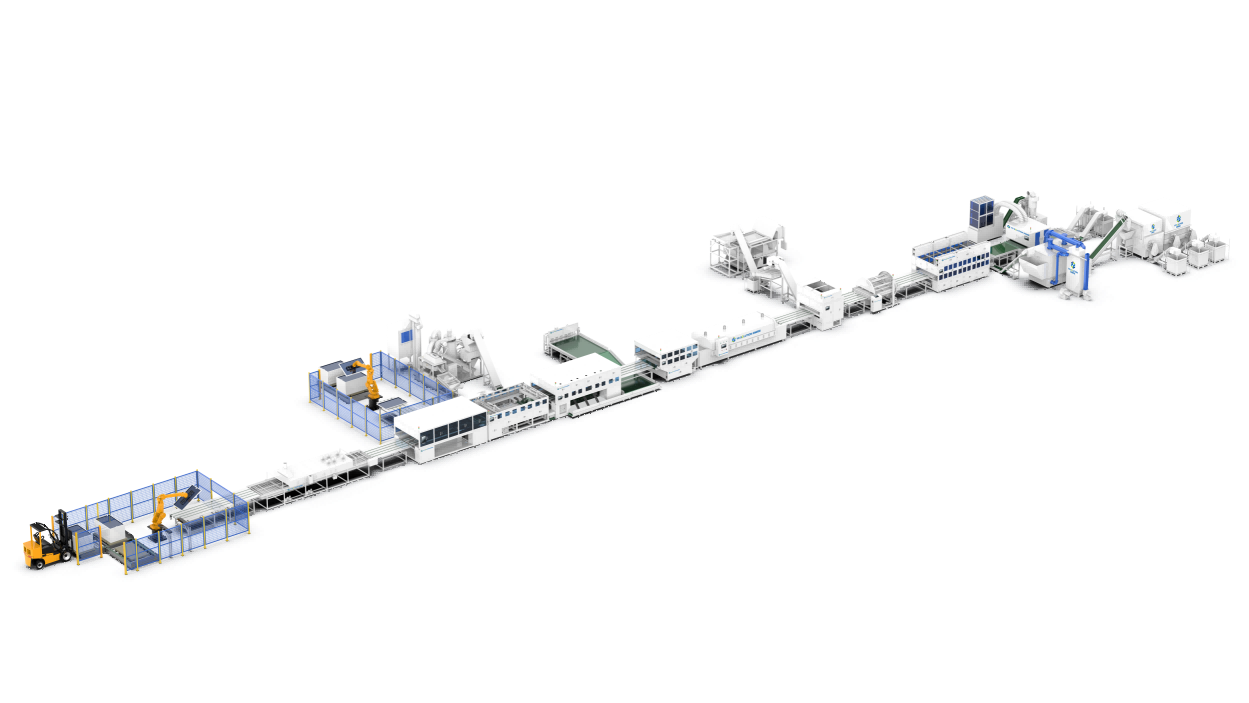
Complete line layout
Review the main equipment modules along the complete line, from front-end handling to downstream separation.
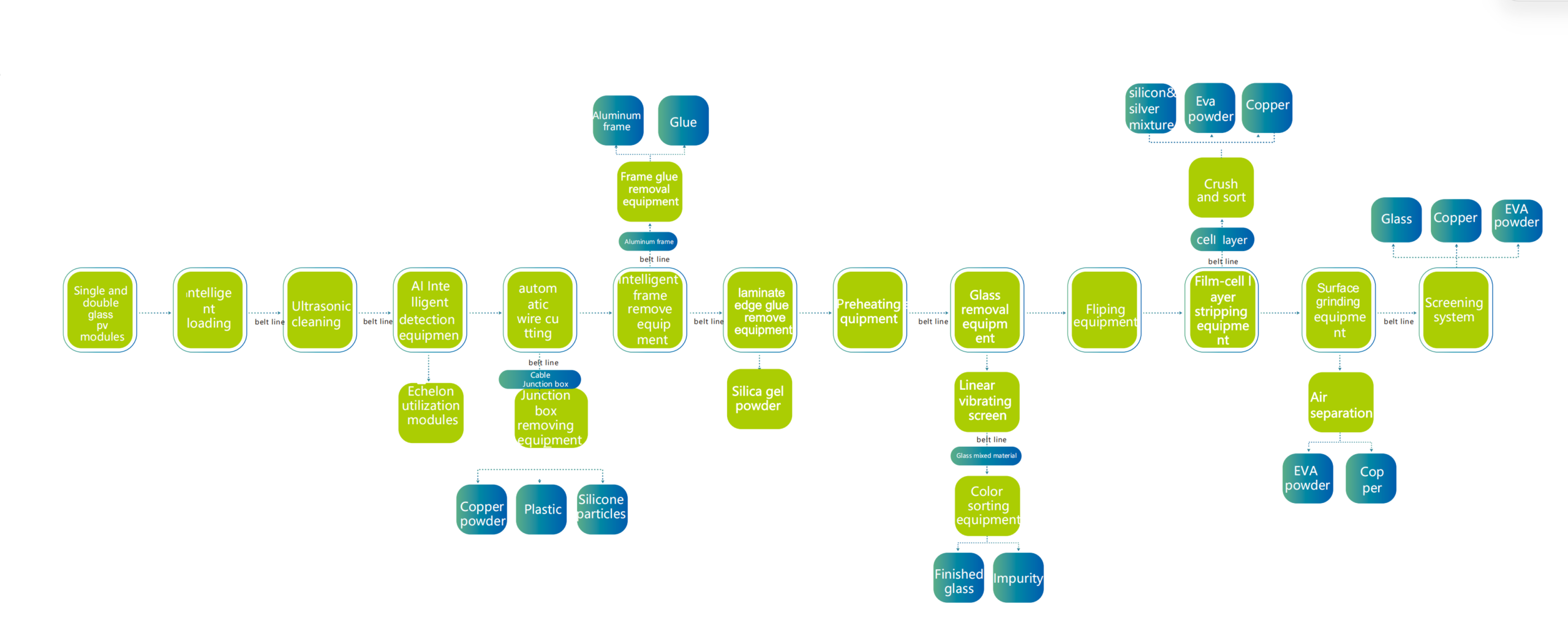
Process flow
The process flow helps match physical pre-treatment, thermal processing, exhaust treatment, and downstream separation into one project plan.
PV modules are fed into the line according to project layout and automation level.
Cleaning, drying, and AI-based sorting can be configured before downstream treatment.
The line removes external components before deeper layer processing.
Mechanical pre-treatment prepares glass, backsheet, encapsulant, and cell layers for selected thermal processing.
Controlled thermal treatment is discussed according to module type, exhaust treatment, and local environmental rules.
Downstream screening and separation modules are configured after engineering confirmation.
Exhaust treatment, emissions management, and site requirements are reviewed project by project.
Final configuration is confirmed after checking module samples, capacity target, and project location.
Application fit
Best for customers who want to evaluate both mechanical separation and thermal processing as part of one integrated route.
Route proposal
Please leave your company name, email, and WhatsApp/phone number. Our engineer will review your module condition and recommend the suitable route configuration.


Required fields: Company Name, Email, and WhatsApp / Phone. Add module photos or capacity target in the message if available.
Project questions
Physical + pyrolysis projects usually need more engineering discussion because the route connects mechanical pre-treatment, thermal processing, exhaust treatment, and downstream separation. These answers help visitors understand what must be confirmed before quotation.


The Physical + Pyrolysis route combines front-end mechanical dismantling with selected controlled thermal processing. In practice, the line can first handle module feeding, cleaning, inspection, junction box removal, frame removal, edge-glue treatment, and layer preparation before pyrolysis is considered for selected material layers.
This route is not recommended as a generic answer for every customer. It is mainly used when the project needs deeper material liberation than a physical-only route can reasonably provide, and when the project site can support exhaust treatment, safety planning, and local environmental review.
It should be considered when the customer wants to compare a higher-depth recovery route with a pure physical process. For example, if the target is to evaluate encapsulant, backsheet, or cell-layer treatment after physical dismantling, this route can become part of the engineering discussion.
Before recommendation, our engineer should review the module type, damage condition, expected capacity, workshop layout, local permitting requirements, and downstream material plan. Without those details, it is safer to present this as an option rather than a fixed final solution.
Single-glass crystalline silicon modules can be evaluated for this route. The physical pre-treatment section can be configured according to module size, frame structure, junction box design, backsheet condition, and target automation level.
The final route still depends on whether the project actually needs pyrolysis after mechanical treatment. If the customer's environmental requirements or budget make thermal processing unsuitable, a physical precision disassembly route or another physical configuration may be more appropriate.
Double-glass modules can be reviewed, but they should not be treated as identical to single-glass modules. Glass thickness, breakage level, laminate structure, and whether rear glass needs to be protected will influence the equipment sequence and process settings.
For double-glass projects, we should ask for module photos, sample information, and the customer's target result before giving a route recommendation. In some cases, physical pre-treatment is enough; in other cases, selected thermal treatment may be discussed after compliance review.
Yes. Any route involving pyrolysis must include exhaust treatment, odor control, operating safety, and local environmental compliance as part of the process plan. This is why we should avoid promising a final configuration before the project location and permitting conditions are understood.
For customer communication, the correct approach is to collect contact information and project details, then let sales and engineering confirm whether pyrolysis is suitable. The visitor should understand that pyrolysis is an engineered route, not a simple plug-in machine.
No fixed recovery guarantee should be given before engineering review. Recovery results depend on incoming modules and final line configuration.
Capacity depends on module size, condition, automation level, and selected process route. Our engineer can recommend a configuration after reviewing project details.
It can be suitable where local environmental approval and exhaust treatment requirements can be met. Many overseas projects compare this route with physical-only routes first.
Please provide company name, email, WhatsApp/phone, module type, project location, expected capacity, and module photos if available.
Automation level can be configured. Feeding, sorting, dismantling, and downstream handling can be manual, semi-automatic, or more automated according to budget and layout.
Usually it is discussed as a fixed-line project because thermal processing and exhaust treatment require planned site conditions.
Mobile deployment needs separate engineering review. Thermal sections and exhaust treatment may limit mobile configuration.
Our team reviews module structure, condition, local regulations, target process depth, and capacity before recommending the route.
Damaged panels can be reviewed, but severely broken or irregular modules may be better suited to a pure physical crushing route.
Leave your company name, email, and WhatsApp/phone number. Our engineer will follow up with route selection questions.
새 기사 알림 받기
아래 양식을 작성해 주시면 곧 연락드리겠습니다.