YCSOLUTION PROCESS ROUTE

مسار عملية إعادة تدوير الوحدات الكهروضوئية بالطرق الفيزيائية والانحلال الحراري

A purity-first combined route: mechanical separation removes clean high-volume fractions first, then selected pyrolysis unlocks the encapsulant-cell layers that need deeper liberation.

المزايا الأساسية

لماذا تختار هذا المسار؟

This hybrid route is designed for projects that need cleaner recovery fractions than precision mechanical disassembly alone. It separates frames, glass, junction boxes and backing materials first, then applies controlled pyrolysis only to the encapsulant-cell layer. The result is higher-purity liberated material, intact or large-format recovery where possible, and lower thermal demand than treating whole modules by pure pyrolysis.

Higher-purity encapsulant-layer recovery

Controlled pyrolysis breaks the remaining polymer bonds after precision mechanical separation, producing cleaner silicon-silver and copper-bearing fractions than a purely mechanical precision-disassembly route.

Intact backsheet and large glass recovery

Layered mechanical separation preserves a complete backsheet from single-glass modules and recovers large, clean glass pieces from double-glass modules, improving handling and resale value.

Single- and double-glass compatibility

One line can process both single-glass and double-glass crystalline-silicon modules without separate production lines, with process parameters adjusted to the module structure.

Heat recovery with lower energy demand

Only the difficult-to-separate encapsulant-cell layer is pyrolyzed. Recovered process heat is reused for preheating and pyrolysis, so energy demand is lower than whole-module pure pyrolysis.

تصميم خط الإنتاج بالكامل

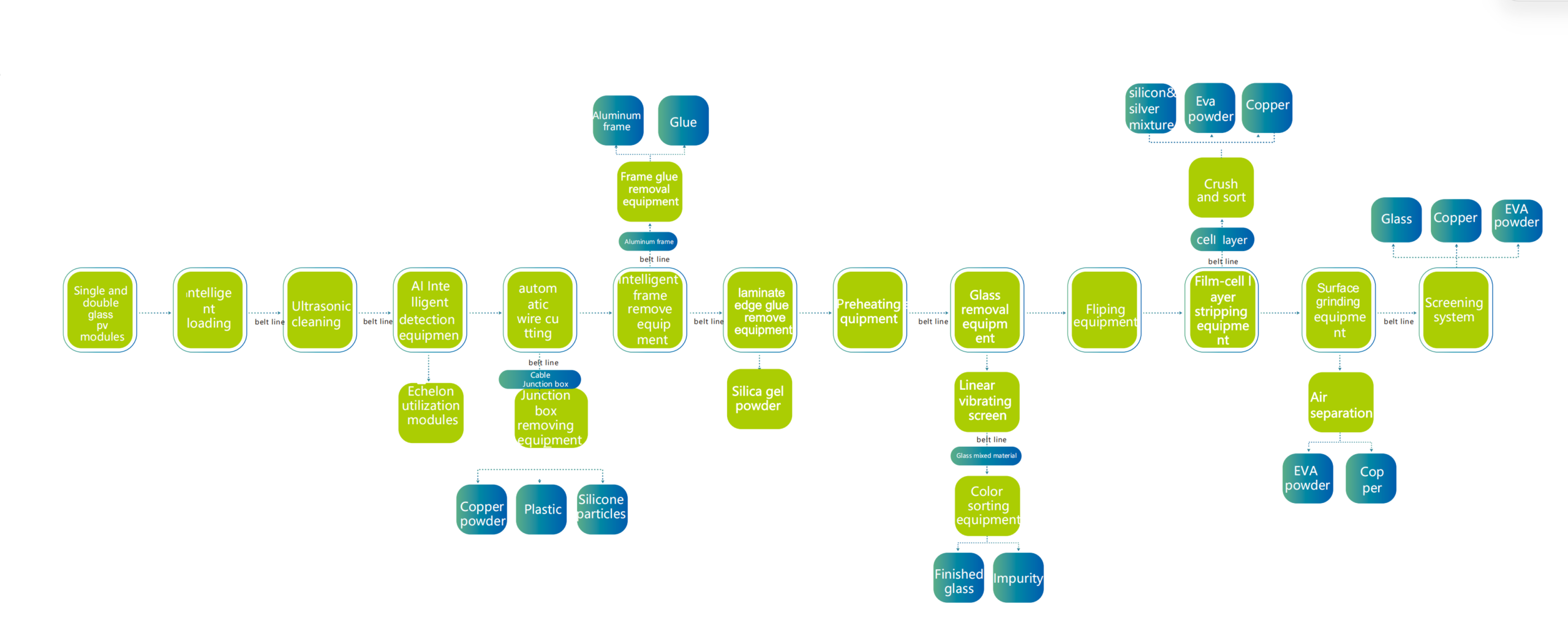
تسلسل المعدات على المسار الكامل

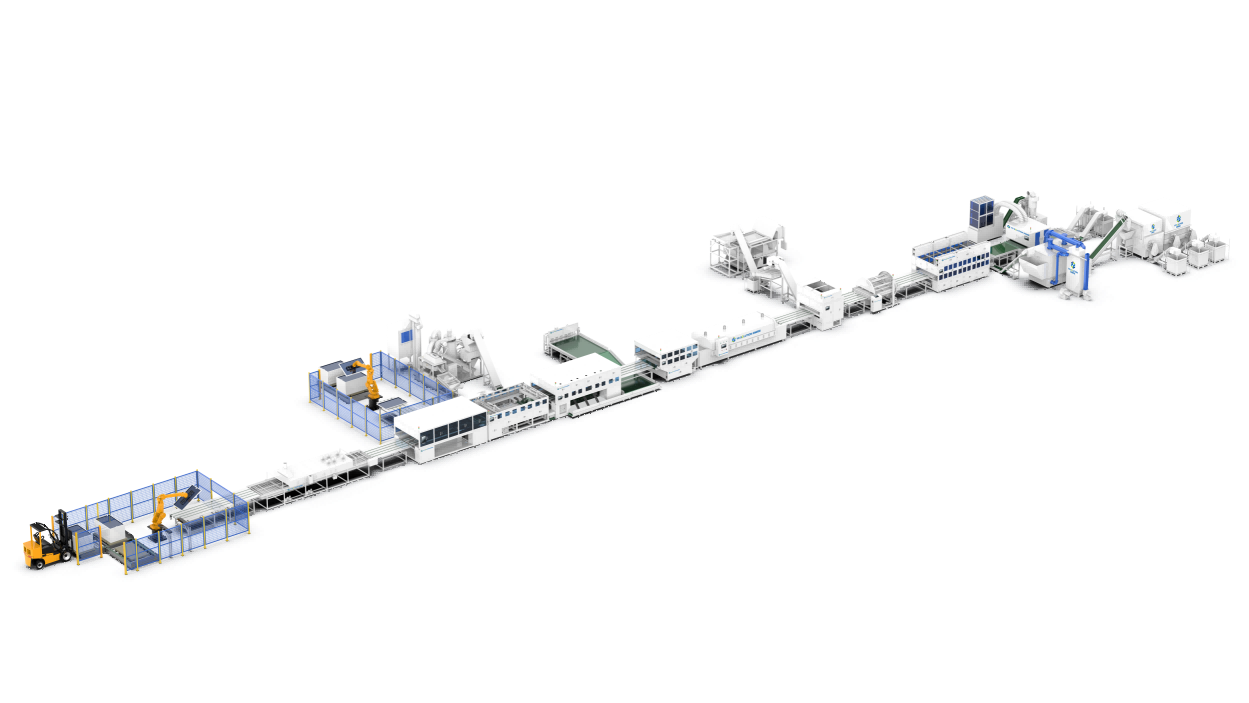
Physical plus pyrolysis PV module recycling line layout
1. Loading Machine

1. Loading Machine

2. Ultrasonic Cleaning Machine

2. Ultrasonic Cleaning Machine

3. AI Inspection System

3. AI Inspection System

4. Automatic Cable Cutting and Junction Box Removal

4. Automatic Cable Cutting and Junction Box Removal

5. Frame Removal Machine

5. Frame Removal Machine

6. Laminated Module Edge Sealant Removal

6. Laminated Module Edge Sealant Removal

7. Preheating System

7. Preheating System

8. Glass Separator

8. Glass Separator

9. Flipping Machine

9. Flipping Machine

10. Encapsulant-cell Layer Separation

10. Encapsulant-cell Layer Separation

11. Backsheet and Glass Cleaning

11. Backsheet and Glass Cleaning

12. Airflow Separator

12. Airflow Separator

13. Glass Sorting System

13. Glass Sorting System

14. Linear Screener

14. Linear Screener

15. Frame Groove Cleaning

15. Frame Groove Cleaning

16. Junction Box Processing

16. Junction Box Processing

17. Pyrolysis Furnace

17. Pyrolysis Furnace

18. Pyrolysis Product Screener

18. Pyrolysis Product Screener

مسار العملية

المعالجة المسبقة الفيزيائية + التحلل الحراري المتحكم فيه

يساعد مخطط سير العملية على دمج المعالجة المسبقة الفيزيائية، والمعالجة الحرارية، ومعالجة العادم، وعمليات الفصل اللاحقة في خطة مشروع واحدة.

01

التغذية والتنظيف الذكيان

يبدأ خط الإنتاج بعمليات التغذية الذكية والتنظيف بالموجات فوق الصوتية والفحص باستخدام الذكاء الاصطناعي، بحيث تتلقى مراحل التفكيك اللاحقة وحدات أكثر استقرارًا.

02

معالجة الكابلات وصناديق التوصيل والإطارات

يتم فصل المكونات الخارجية وشظايا الألومنيوم من خلال عمليات قطع الكابلات تلقائيًا، وإزالة صناديق التوصيل، وإزالة الإطارات، وتنظيف أخاديد الإطارات، ومعالجة الحواف بمواد مانعة للتسرب.

03

تحضير الزجاج والمواد المركبة

تعمل عمليات التسخين المسبق، وفصل الزجاج، والقلب، وفصل طبقة المادة العازلة عن الخلايا على تجهيز تدفقات المواد قبل الوصول إلى القسم الحراري المحدد.

04

فصل المواد في الفرع

يساعد فرز الزجاج، والغربلة الخطية، وتنظيف الطبقة الخلفية والزجاج، ومعالجة صناديق التوصيل، والفصل بتدفق الهواء، على عزل الأجزاء المتفرعة قبل عملية التحسين النهائية.

05

الانحلال الحراري الخاضع للرقابة

The pyrolysis furnace thermally decomposes remaining encapsulant and polymer structures under engineered process conditions.

06

Pyrolysis product screening

After thermal treatment, pyrolysis product screening and downstream physical sorting improve recovered material purity.

07

Environmental and safety review

Exhaust treatment, process-gas management, safety controls and local permitting are reviewed project by project.

08

Proposal confirmation

Final configuration is confirmed after checking module samples, target capacity, workshop layout and project location.

Application fit

Suitable Project Scenarios

  • Projects requiring deeper treatment of encapsulant or cell-layer structures after physical pre-treatment.
  • Fixed recycling plants with space for thermal process and exhaust-treatment planning.
  • Customers comparing physical-only and pyrolysis-assisted recycling routes.
  • Projects where local environmental approval can support thermal processing after professional review.
  • Single-glass or double-glass crystalline silicon module projects that need route selection before quotation.

Route proposal

Request Your Engineering Route Review

Please leave your company name, email, and WhatsApp/phone number. Our engineer will review your module condition and recommend the suitable route configuration.

  • Best for projects comparing physical-only and pyrolysis-assisted separation.
  • Exhaust treatment and local environmental rules must be reviewed before quotation.
  • Share module condition, project location, and capacity target for route confirmation.
Physical plus pyrolysis PV module recycling line layout

الأسئلة الشائعة

Project questions

الأسئلة الشائعة

Physical + pyrolysis projects usually need more engineering discussion because the route connects mechanical pre-treatment, thermal processing, exhaust treatment, and downstream separation. These answers help visitors understand what must be confirmed before quotation.

Physical plus pyrolysis PV module recycling line layout

The Physical + Pyrolysis route combines front-end mechanical dismantling with selected controlled thermal processing. In practice, the line can include intelligent feeding, ultrasonic cleaning, AI inspection, cable cutting, junction box removal, frame removal, frame groove cleaning, edge-sealant removal, preheating, glass separation, encapsulant-cell layer separation, pyrolysis, and product screening.

This route is not recommended as a generic answer for every customer. It is mainly used when the project needs deeper material liberation than a physical-only route can reasonably provide, and when the project site can support exhaust treatment, safety planning, and local environmental review.
It should be considered when the customer wants to compare a higher-depth recovery route with a pure physical process. For example, if the target is to evaluate encapsulant, backsheet, or cell-layer treatment after physical dismantling, this route can become part of the engineering discussion.

Before recommendation, our engineer should review the module type, damage condition, expected capacity, workshop layout, local permitting requirements, and downstream material plan. Without those details, it is safer to present this as an option rather than a fixed final solution.

Single-glass crystalline silicon modules can be evaluated for this route. The physical pre-treatment section can be configured according to module size, frame structure, junction box design, backsheet condition, and target automation level.

The final route still depends on whether the project actually needs pyrolysis after mechanical treatment. If the customer’s environmental requirements or budget make thermal processing unsuitable, a physical precision disassembly route or another physical configuration may be more appropriate.

Double-glass modules can be reviewed, but they should not be treated as identical to single-glass modules. Glass thickness, breakage level, laminate structure, and whether rear glass needs to be protected will influence the equipment sequence and process settings.

For double-glass projects, we should ask for module photos, sample information, and the customer’s target result before giving a route recommendation. In some cases, physical pre-treatment is enough; in other cases, selected thermal treatment may be discussed after compliance review.

Yes. Any route involving pyrolysis must include exhaust treatment, odor control, operating safety, and local environmental compliance as part of the process plan. This is why we should avoid promising a final configuration before the project location and permitting conditions are understood.

For customer communication, the correct approach is to collect contact information and project details, then let sales and engineering confirm whether pyrolysis is suitable. The visitor should understand that pyrolysis is an engineered route, not a simple plug-in machine.

No fixed recovery guarantee should be given before engineering review. Recovery results depend on incoming modules and final line configuration.

Capacity depends on module size, condition, automation level, and selected process route. Our engineer can recommend a configuration after reviewing project details.

It can be suitable where local environmental approval and exhaust treatment requirements can be met. Many overseas projects compare this route with physical-only routes first.

Please provide company name, email, WhatsApp/phone, module type, project location, expected capacity, and module photos if available.

يمكن ضبط مستوى الأتمتة. ويمكن أن تتم عمليات التغذية والفرز والتفكيك والمناولة اللاحقة يدويًّا أو شبه آليًّا أو بدرجة أعلى من الأتمتة، وفقًا للميزانية وتصميم المنشأة.

عادةً ما يُنظر إلى هذا المشروع على أنه مشروع للخط الثابت، لأن المعالجة الحرارية ومعالجة العادم تتطلبان ظروفًا مخططة للموقع.

يتطلب النشر في الأجهزة المحمولة مراجعة هندسية منفصلة. وقد تحد الأجزاء الحرارية ومعالجة العادم من إمكانيات التكوين في الأجهزة المحمولة.

يقوم فريقنا بمراجعة هيكل الوحدة وحالتها واللوائح المحلية وعمق العملية المستهدف والقدرة الاستيعابية قبل التوصية بالمسار المناسب.

يمكن فحص الألواح التالفة، لكن قد يكون من الأفضل معالجة الوحدات المكسورة بشدة أو غير المنتظمة عن طريق السحق المادي البحت.

يرجى إدخال اسم شركتك وعنوان بريدك الإلكتروني ورقم هاتفك أو رقم WhatsApp. وسيقوم مهندسنا بالاتصال بك لطرح بعض الأسئلة المتعلقة باختيار المسار.

Industry Insight · Pillar–Cluster Guide

Quick answer: physical + pyrolysis pv module recycling process route

This page answers the buyer intent behind physical + pyrolysis pv module recycling process route, solar panel recycling process, PV module recycling equipment, end-of-life PV recycling, physical recycling process, thermal recycling route, PV material recovery, recycling process route, crystalline-silicon module recycling, recovery rate verification. These phrases are used as engineering concepts—not as a repetitive keyword list—so the page remains useful to Google, AI answer engines and project teams.

Continue the decision path with physical solar panel recycling و solar panel recycling with pyrolysis. Both pages expand the same project question from a different technical or commercial angle.

physical + pyrolysis pv module recycling process route - Physical and thermal PV module recycling process route
Physical and thermal PV module recycling process route — YCSOLUTION engineering reference.
physical + pyrolysis pv module recycling process route - Pure physical PV module recycling process flow
Pure physical PV module recycling process flow — YCSOLUTION engineering reference.

Practical Summary

  • Define feedstock and target output before comparing equipment.
  • Verify capacity, purity and recovery claims with representative material and written test criteria.
  • Use the related cluster pages below to compare route, site, compliance and commercial decisions.

Build a Project-Specific Recycling Solution

Share the material type, condition, annual volume, target output, destination country and site constraints. YCSOLUTION will map the suitable equipment route, interfaces and acceptance criteria.

Explore the complete solution · Discuss the project with Jessie Liu

arالعربية
تلقي آخر الأخبار

اشترك في نشرتنا الإخبارية الأسبوعية

احصل على تنبيهات حول المقالات الجديدة

احصل على أفضل عرض أسعار

املأ النموذج أدناه، وسنتواصل معك قريباً.

معلومات الاتصال
معلومات المنتج
الرسالة